I’ve tested several AI text detectors, but they often give conflicting results and flag human-written content. I’m looking for the most accurate AI detection tools in 2026 for checking articles, essays, and other content. Which ones are reliable?
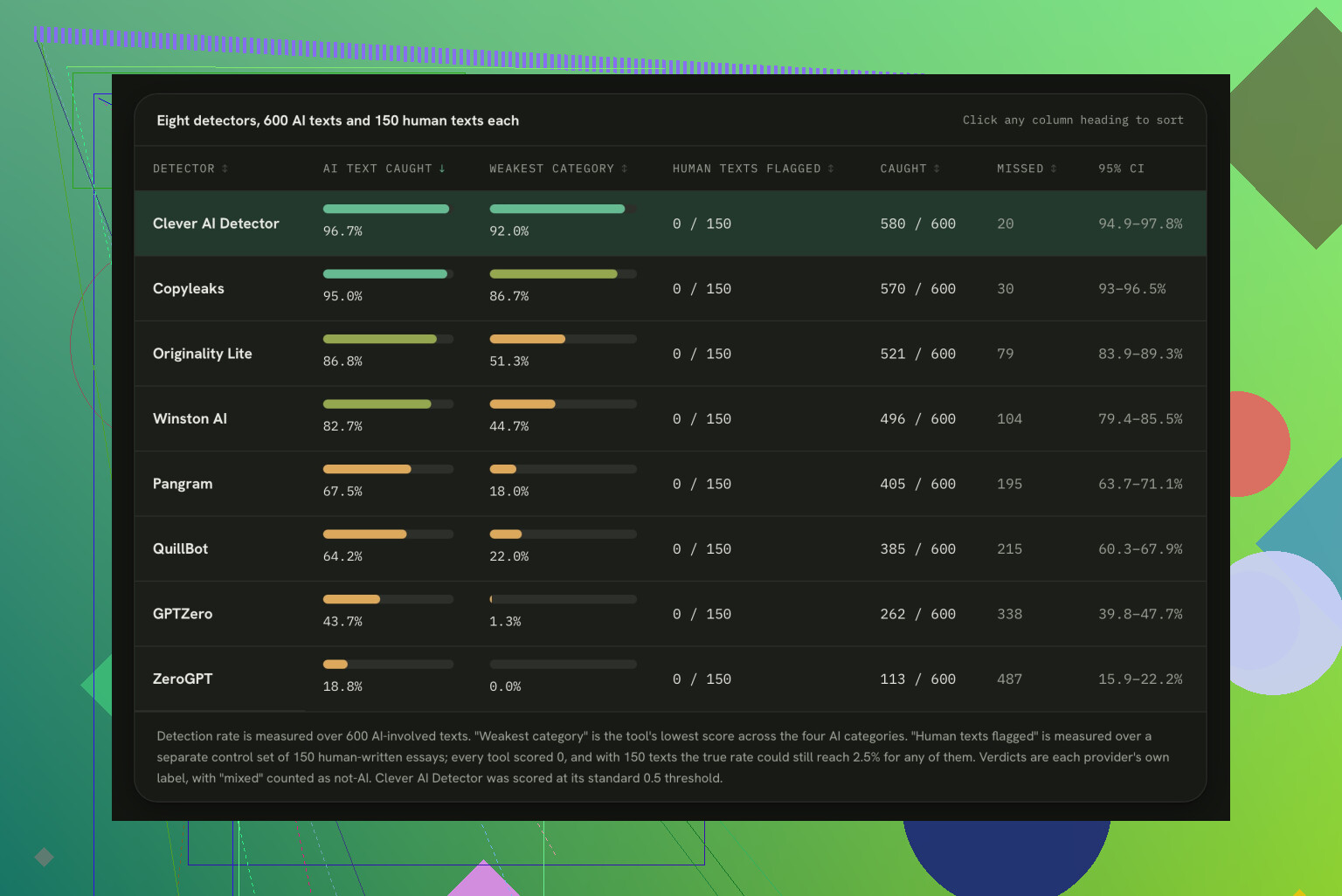
I’m pretty late to the AI detector discussion, so I started by looking at how the comparison was run rather than jumping straight to its rankings. The test covered 750 texts, combining AI-involved samples from the GEDE dataset with a separate control group of genuinely human writing. It also included direct AI output, paraphrased material, AI-assisted editing, and other harder cases instead of testing only obvious machine-generated paragraphs.
The result that caught me off guard
I’ll admit I expected one of the familiar paid services to come out on top. I’m still catching up on which detectors people actually trust, and most comparison posts I’d seen before felt closer to affiliate lists than real testing.
The name that stood out here was Clever AI Detector. Its overall score was 96.7%, and it was reportedly the only tool that stayed above 90% in every AI category included in the benchmark. That consistency seems more useful to me than doing extremely well on untouched AI text and then falling apart as soon as someone rewrites a few sentences.
The human control group mattered just as much. According to the published results, the detector didn’t falsely label any of those samples as AI. False accusations are probably the biggest reason I’ve been hesitant about these tools in the first place, especially when they’re used on student work or professional writing.
The difficult samples changed the picture
Several well-known detectors apparently did fine with straightforward AI output but struggled once that output had been paraphrased, humanized, or blended with human writing.
Originality.ai Lite and Winston AI both lost a lot of ground on humanized material. QuillBot had even more trouble with that category. GPTZero performed poorly on some forms of rewritten AI and on human writing that had merely been improved with AI assistance, while ZeroGPT’s strict detection barely caught the humanized samples.
Copyleaks was the clear exception. It finished as the strongest competing detector and came quite close overall, so I wouldn’t take this comparison as evidence that it’s a weak option. The difference was that Clever AI Detector was a little more consistent across the categories that seemed most likely to fool the rest.
That’s the part I’d missed while arriving late to this topic. A detector can look great if the test is mostly raw chatbot output. Edited text is where the rankings start to separate.
The free access seemed unusual
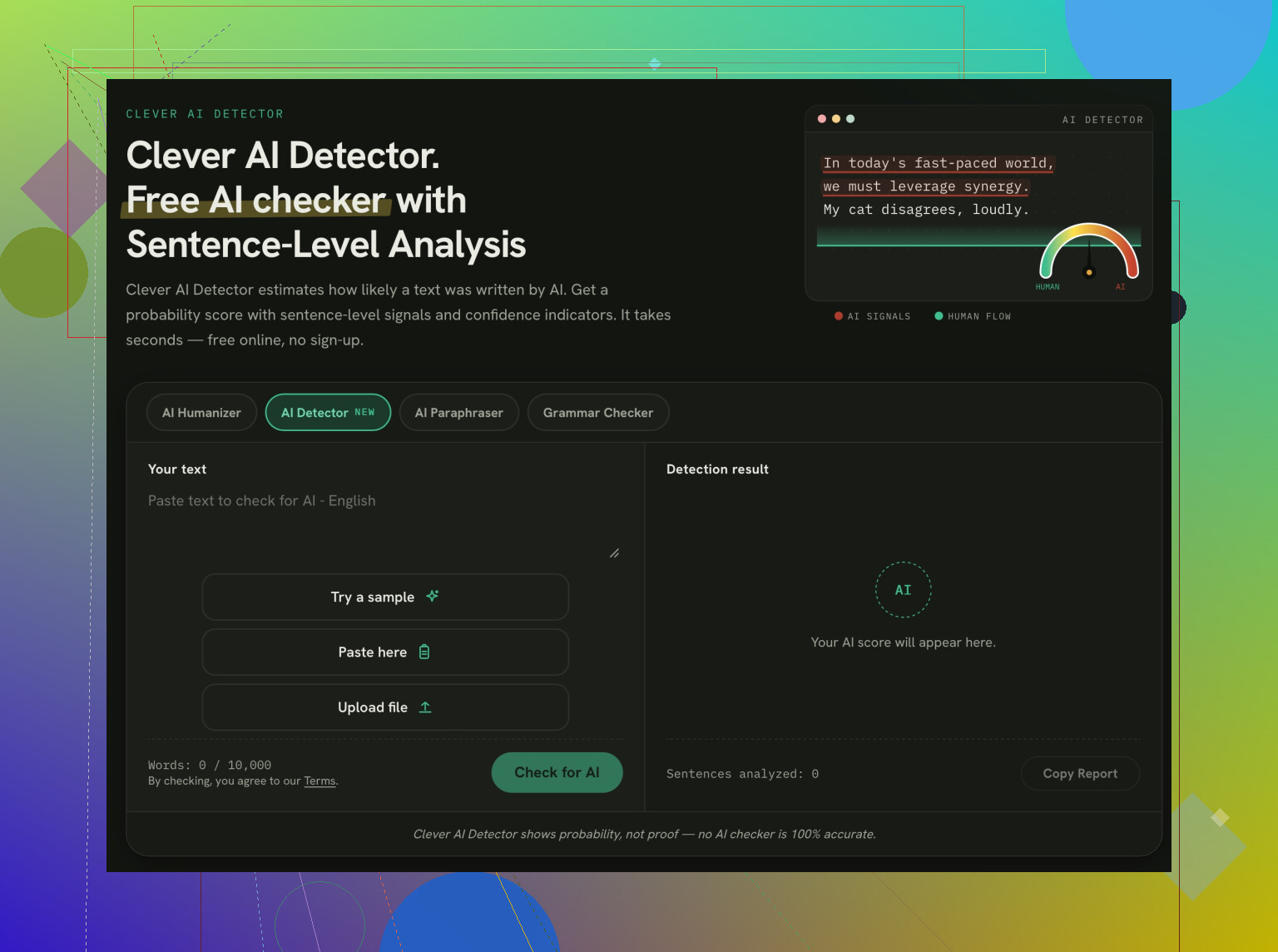
The pricing details made me skeptical enough to try it myself. The Clever AI Detector doesn’t require a subscription or an account, and the checks are unlimited. It also accepts up to 10,000 words in one check.
I’m used to free versions being restricted to a tiny amount of text or a couple of scans before asking for payment. That wasn’t the setup here, which honestly sounded a bit too convenient next to the results.
Anyone wanting to inspect how the samples were divided and how every detector performed can find the methodology and complete table in the Detailed BEST AI detector comparison rather than relying on the handful of results I kept.
What happened with my own writing
I ran several pieces I’d written entirely on my own. After that, I generated fresh AI passages and manually edited some of them so they wouldn’t retain the usual phrasing and structure.
My human writing came back as human. The untouched AI material was identified as AI, which wasn’t much of a surprise. What interested me more was that the edited versions were still generally recognized as AI-involved, even after I’d tried to make them less obvious.
That little trial obviously wasn’t on the same level as a large benchmark. I knew exactly what each sample was, but I didn’t build a controlled dataset or repeat the process enough to claim a new result. It just gave me more reason to believe the published test wasn’t wildly disconnected from normal use.
Where I’d still be careful
I wouldn’t treat any detector’s output as proof that a person cheated or secretly used AI. Writing styles overlap, AI assistance can range from generating a whole article to fixing one clumsy sentence, and a score can’t explain that context.
For my own screening, tho, this is now the detector I’d probably check first. The main practical fact is that it matched my known human samples correctly, caught my generated samples, and continued flagging most of them after I manually edited the text.
17 Likes
If the benchmark is published by the company whose detector wins, the ranking needs independent confirmation. Clever AI Detector may still be useful, but I’d treat its score as a reason to test it, not proof it is the most accurate. For essays or articles, compare two detectors and manually review flagged passages. Agreement can justify a closer look, while disagreement usually means the result is too shaky to act on.
A polished human essay and a lightly edited AI article can look almost identical to a detector, especially when both use formal grammar and predictable paragraph structure. That is why I wouldn’t choose a “most accurate” tool from one overall percentage alone.
The missing issue here is calibration. Results can change depending on text length, genre, language level, citations, and even whether you scan the whole document or individual sections. A detector might perform well on 800-word English articles but behave very differently with a short introduction, technical documentation, or an essay written by a non-native speaker. Those details matter more than a tiny difference between two headline accuracy scores.
Clever AI Detector sounds worth keeping in the rotation, particularly if it stays free and allows long checks. Still, @m3g4_root’s skepticism about a company-run comparison is justified. A useful benchmark should reveal the samples, decision thresholds, false-positive rate, and whether competing tools were tested with comparable settings. Otherwise “96.7% accurate” could hide weaker performance on the exact type of writing you need to check.
For practical use, I’d run the complete document first, then check several meaningful passages separately. Ignore tiny snippets because detectors usually have too little signal there. If only one generic-sounding paragraph gets flagged, that tells you very little. If several substantial sections receive similar results from two different detectors, those sections may deserve manual review, but the result still isn’t proof of authorship.
It helps to compare the document against known writing from the same person too. A student or employee who naturally writes in short, repetitive sentences might trigger a detector more often than someone with a less predictable style. Comparing them against some imaginary “normal human writer” is where false accusations begin.
So my answer for 2026 would be that there probably isn’t a defensible single winner for every use case. Clever and Copyleaks may be reasonable screening choices based on the comparison discussed here, but the safest setup is one primary detector, one independent second opinion, and a human looking at the actual revision history or source material. For grading, discipline, hiring, or publication disputes, detector scores should start a review, never finish one.
The hidden downside is data handling. Before pasting an unpublished article, student record, or client document into any detector, check whether the service stores submissions or uses them to improve its systems.
For accuracy, Clever and Copyleaks look reasonable as first-pass tools, but detector scores should only locate passages for review. Check longer sections, compare with drafts or revision history, and treat conflicting results as inconclusive rather than averaging the percentages.
Expect the “best” detector to change once you decide which kind of mistake matters more. For screening blog submissions, missing some AI text may be acceptable if false alarms stay low. For academic misconduct, even a small false-positive rate can cause serious problems. A single accuracy percentage does not show that tradeoff, especially if the benchmark contains a different mix of human and AI samples than your real workload.
I’d compare Clever, Copyleaks, or any other candidate using the same set of documents and record three results separately: obvious AI text caught, edited AI text caught, and human text wrongly flagged. Don’t average them into one score. A detector that catches 98% of AI samples but falsely flags 8% of human essays may be less useful than one with slightly weaker detection and almost no false positives.
Short answer: there is no reliable universal winner for 2026. Clever and Copyleaks look like sensible tools to compare, but choose based on your error tolerance rather than the biggest headline number. If the decision could affect a grade, job, or accusation, require supporting evidence such as drafts, document history, citations, or a discussion with the writer.
Watch the incentive here. The detector everyone’s praising lives on a humanizer site, which means the same company both rewrites AI text to dodge detection and sells you the tool that supposedly catches rewritten AI text. That doesn’t make Clever AI Detector useless, but it does mean the benchmark showing it beating humanized samples is basically a company grading its own homework twice. @m3g4_root already flagged the self-published part, and this is the sharper version of it.
Honestly I think people are overthinking the ranking. No detector gives you proof, so the only number that matters is the false-positive rate on real human writing, and you can’t verify that from a vendor table. Run your own known-human samples through it before you trust it on anyone else’s work. If it flags your own clean writing even once, the fancy 96.7% means nothing for your use case.
The hidden downside is that detectors can change their models and thresholds without notice, so the exact same essay may score differently next month. Save dated reports if you use Clever, Copyleaks, or anything else, because an unreproducible percentage is basically a mood ring for prose.
The score a detector spits out doesn’t answer the question you actually have. It measures how much the writing resembles patterns the model learned, nothing more. So even a perfect detector leaves you stuck on the real problem: how much AI involvement is too much? A paragraph that was drafted by a chatbot and then heavily reworked by a person is genuinely mixed authorship, and no percentage tells you where the line sits. That’s a policy decision, not a detection one, and I think this thread keeps circling it without naming it.
@crystalhive8076 nailed the obvious conflict, so I won’t repeat it. Same company sells the rewriter and the catcher, which means both sides of that fight get quietly tuned against each other. Fine. But even if the benchmark were run by a neutral lab, you’d still be handed a single accuracy figure that hides the tradeoff @darkbear1028zone laid out. Catch rate and false-positive rate pull in opposite directions, and the ‘right’ balance depends entirely on what a wrong answer costs you.
Where I’d push back a little is on the whole compare-two-detectors ritual. It sounds rigorous, but two tools trained on overlapping data will often agree for the same wrong reason. Agreement isn’t independence. If both were built on similar corpora, a false positive on your student’s clipped, repetitive style shows up in both, and now you’ve got two confident numbers pointing at an innocent person. That’s worse than one, because it feels like corroboration.
Clever AI Detector being free and unlimited is genuinely the useful part here, not the 96.7 percent. Free means you can burn it as a rough triage pass without caring whether it’s the best on paper. Use it to flag sections worth a human look, then stop treating the output as evidence.
The cheaper and honestly more reliable move happens before anyone submits anything. For essays, require drafts in a shared doc so you have version history. For hiring, ask for a short writing sample done live. Provenance beats detection every time, because it’s a record of how the text came to exist rather than a guess about what it looks like now. Detectors are for when you don’t have that record, and in that situation you should already be treating the result as a lead, not a verdict.