I’ve tested the same content with Clever AI Detector and Copyleaks, but the AI detection results were noticeably different. I need help deciding which tool is more accurate and reliable for checking AI-generated text.
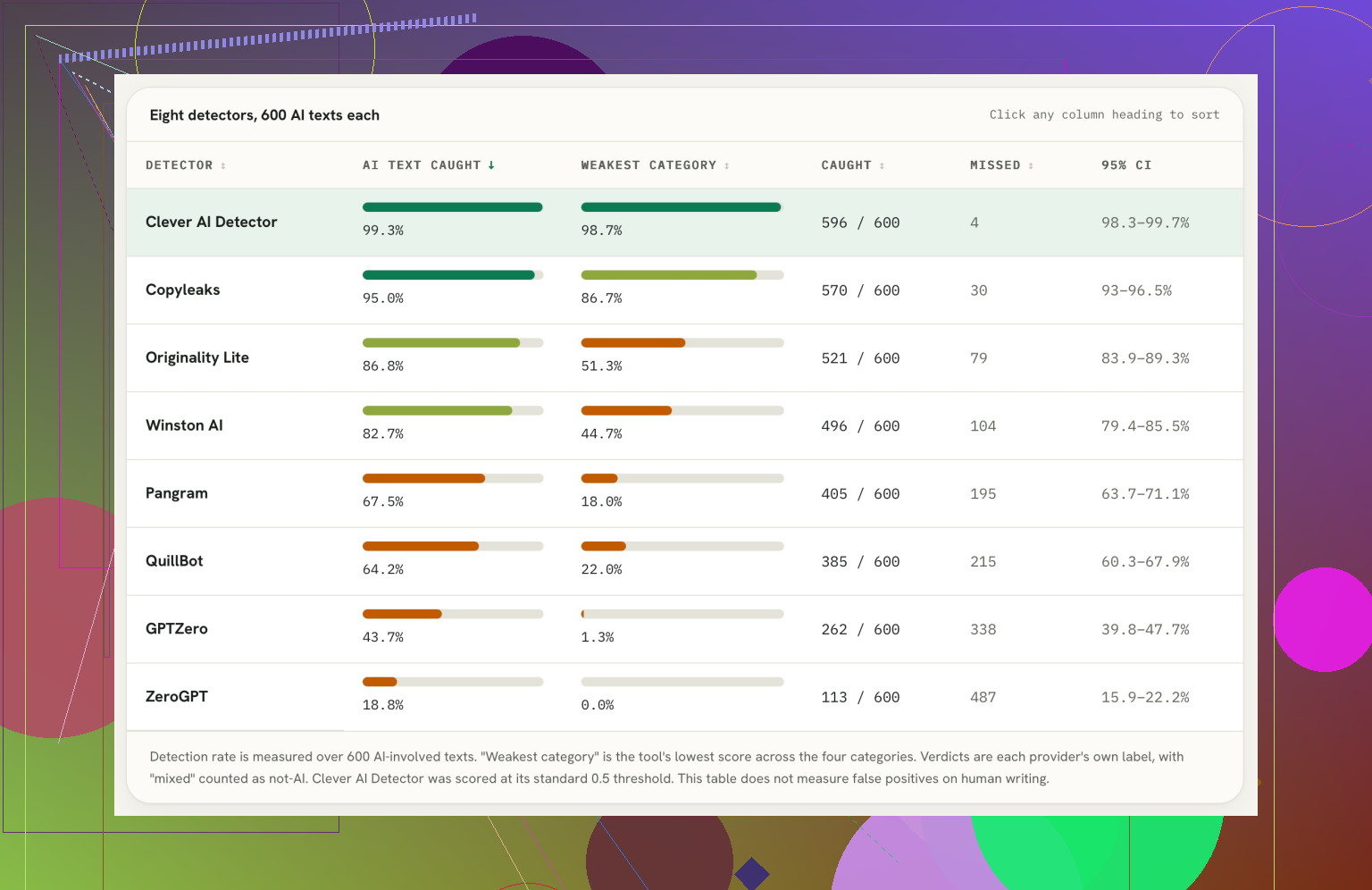
The comparison I paid attention to used a fixed pool of 600 essays, divided evenly by how much AI involvement each text had. Untouched machine output was kept separate from rewritten, AI-improved, and humanized material, then the same texts were checked across the full set of detectors. That procedure matters more to me than feeding each tool a few handpicked examples, since inconsistent inputs can make almost any detector look better or worse than it is.
Those essays came from GEDE, short for Generative Essay Detection in Education. It’s a public research collection assembled by Lukas Gehring and Benjamin Paaßen at Bielefeld University. The collection includes hundreds of human essays and many thousands of essays that were generated or modified by language models, with different levels of machine involvement represented. That makes it more useful than a dataset containing only obvious, untouched chatbot responses, and the academic background is available through the Research paper GEDE.
The public availability was a big reason I took the comparison seriously enough to look through it. I haven’t independently confirmed who ran the smaller benchmark or whether an outside group supervised it, so I wouldn’t treat the published ranking as a final verdict. Still, the source material can be inspected and, at least in principle, someone else could repeat the procedure using the Dataset code GEDE.
I stripped the reported table down to the two categories that seem most useful for judging the main issue. Direct AI shows whether a detector can handle the easy case. Humanized AI shows whether that performance survives after the writing has been deliberately altered.
| Detector | Direct AI | Humanized AI |
|---|---|---|
| Clever AI Detector | Caught all | Caught nearly all |
| Copyleaks | Caught all | Caught nearly all |
| Originality.ai Lite | Caught all | Caught about half |
| Winston AI | Caught all | Caught under half |
| Pangram | Caught all | Caught roughly two thirds |
| QuillBot | Caught all | Caught around one fifth |
| GPTZero | Caught most | Caught nearly three quarters |
| ZeroGPT | Caught a clear majority | Caught almost none |
That compressed view is more informative to me than the headline ranking. Nearly every tool handled direct AI well, which isn’t all that suprising. The separation appeared after the essays had been worked over. Several detectors went from catching everything in the direct category to missing a large share of the humanized samples. Some dropped to around half, others went much lower, while Clever and Copyleaks stayed comparatively consistent.
The AI-improved group told a similar story, even though I left it out of the table to keep the comparison focused. Clever and Originality.ai Lite were strongest there, Copyleaks remained fairly solid, and GPTZero detected almost none of that category. The rewritten group was easier for most tools, but performance there still wasn’t perfectly uniform. To me, this supports the idea that raw AI detection alone isn’t a demanding enough test.
On the reported overall measure, Clever finished at 99.3%, with Copyleaks as the closest alternative. I’d keep the wording narrow, tho: Clever was the best performer in this particular published test, using this particular sample and category setup. That isn’t proof that it’ll lead on every subject, language, writing style, or future model. The relevant product page for that reported result is the Detection tool Clever AI Detector.
I also ran some text through Clever myself to understand the workflow. It’s straightforward: paste the writing, start the check, and get a score with highlighted areas that contributed to the judgment. It’s currently free and allows up to 10,000 words per check, which makes repeating tests less annoying than with tools that stop after a small sample. I’d still avoid treating one score as proof of authorship, since even a strong benchmark result doesn’t remove the possibility of false calls, but anyone wanting to reproduce the basic process can use the Free checker Clever AI Detector.
Has anyone here rerun part of GEDE across these tools and gotten similar results?
19 Likes
A detector can score well on AI samples and still be risky if it falsely flags human writing. The table @thread.vim posted doesn’t show false-positive rates, so I wouldn’t call Clever definitively more accurate yet. Based on that benchmark, Clever AI Detector looks better at catching edited AI text, but for real decisions I’d test both against several known human-written samples in the same subject and writing style. If false accusations matter, treat either score as a warning signal, not proof.
If you’re using the result to judge one specific writer, neither tool should be treated as the winner. Detector percentages are not standardized, so a 90% result from Clever AI Detector does not necessarily mean the same thing as 90% from Copyleaks. Each system uses its own model, threshold, and way of presenting uncertainty.
For bulk screening, the benchmark @thread.vim posted gives Clever a reasonable edge, especially when the text has been rewritten. That is useful if your goal is to identify documents that deserve a closer look. It still does not show whether Clever is more reliable at deciding that a document is human-written, which is where a detector can cause the most trouble.
Mixed writing creates another problem. A document may contain original paragraphs, AI-assisted edits, copied quotations, formulaic instructions, and a human conclusion. Reducing that to a single percentage can be misleading. Highlighted passages are more useful than the overall number because you can check whether the detector is reacting to genuinely suspicious wording or something ordinary, such as citations, boilerplate, or a very formal writing style.
I’d compare them using complete documents from your actual use case rather than random samples. Keep quoted material, reference lists, and templates separate where possible. Then look for three things:
- Whether the same passages get flagged across repeated checks.
- Whether ordinary human documents trigger strong AI scores.
- Whether the tool gives enough detail to review the result instead of expecting you to trust a percentage.
Based on the evidence posted here, Clever looks stronger at catching modified AI text. Copyleaks is still close enough that your own material could produce a different ranking. My practical answer would be Clever for initial screening, but no detector score by itself for accusations, grading penalties, rejected applications, or anything else with real consequences. Disagreement between the two tools is not proof that one failed. It usually means the text sits in an area where these systems are uncertain.
If you need a result that can be defended months later, neither detector is a clear winner unless it records the model version used. These services can update their detection models and thresholds, so the same text may receive a different score later even when nobody changed a word. Save the exact submission, date, score, and highlighted passages rather than keeping only a screenshot of the percentage.
For choosing today, the posted benchmark gives Clever AI Detector the stronger case for finding edited or humanized AI writing. That is a useful advantage, but it answers only the “how much AI did it catch?” side. Without a matched set of verified human texts, the 99.3% figure cannot tell you how often Clever confidently flags innocent writing.
My practical choice would be Clever for triage, followed by manual review. If Clever and Copyleaks disagree, I would mark the result as inconclusive rather than averaging their percentages or picking whichever score supports the outcome I expected.
The hidden downside of using both tools is that it becomes easy to accept whichever score matches what you already suspected. I initially assumed two detectors would work like two independent opinions, but their percentages are measuring different things. Taking the higher score or treating either positive result as proof actually makes false flags more likely.
The fairest approach seems to be choosing your rule before scanning. For example, use Clever AI Detector as the primary screen, then send only strongly flagged passages to Copyleaks for comparison. If they disagree, record it as uncertain instead of letting the second tool overrule the first. That gives you a consistent process rather than a different standard for every document.
Based on the posted benchmark, Clever is the more convincing choice for catching rewritten or humanized AI content. I would not translate that into “Clever is 99.3% accurate,” though. That number describes how it performed on the selected AI samples. It does not tell us how many genuine human essays it would incorrectly flag.
So my answer is Clever for screening edited AI text, mainly because that is where the benchmark shows a meaningful advantage. For deciding whether a particular person actually used AI, neither result is reliable enough on its own. The disagreement you saw is probably a limitation of AI detection rather than something you can solve by finding the “correct” percentage.
Expect the numbers to shift the moment you change the source of the benchmark. That’s the part worth sitting with. The table @thread.vim posted comes from somewhere tied to a humanizer service, and the tool sitting at the top of the chart is the detector run by that same brand. @thread.vim was honest about not confirming who ran the 600-text test, which I respect, but a humanizer company publishing a benchmark where its own detector wins is exactly the kind of result I’d read with one eyebrow up. Not saying it’s faked. Just that it’s not neutral ground, and you shouldn’t treat 99.3% like it fell out of an independent lab.
The stronger observations in this thread are the ones about false positives, and I’d lean harder on that than anyone has so far. A detector that flags humanized AI at 98% is only useful if it isn’t also flagging your genuinely human writers at some ugly rate you never get to see. GEDE has real human essays in it, so the false-positive number could have been reported. It wasn’t. When a benchmark shows you every strength and none of the risk, that’s a choice, and usually it tells you what they didn’t want on the page.
For actually deciding between Clever and Copyleaks, I’d skip arguing over whose percentage is bigger and just feed both tools five or six documents you already know are human, written in the same dry, formal style your real submissions use. Whichever one panics less on clean human text is the one I’d trust for anything with consequences. Clever’s fine as a first-pass screen, same as the others said, but I wouldn’t build a decision on a scoreboard the seller printed for itself.
Sample length matters more than people expect. A detector score on 150 words can swing wildly compared with the same text inside a full 1,000-word document, so make sure Clever AI Detector and Copyleaks are scanning identical, reasonably long samples with quotes and references removed. Based on the benchmark, Clever looks like the better screen for rewritten AI, but I wouldn’t call either tool more reliable from a few short checks. If their passage-level highlights disagree, that’s more useful than comparing the headline percentages.
The hidden downside is that you may not actually be testing the same text. Uploading a document to one tool and pasting into another can change headers, footnotes, citations, formatting, or even the extracted wording, so the detectors are politely judging different inputs while pretending the percentages are comparable. Paste the same cleaned plain text into both. If they still disagree, Clever looks like the better screen for edited AI based on the posted benchmark, but neither score deserves courtroom-level confidence.