I’m editing a 743-word draft for a personal project and trying to decide whether Undetectable AI is worth testing before I spend more time on it. I read a claim that its rewrites can pass AI detection, but the ‘undetectable’ part sounds a little too convenient. Does that hold up outside examples picked to make it look good?
Can anyone recommend a sensible way to test that claim using the same draft before and after rewriting? I’m already annoyed by how much attention detector scores get compared with readability. Has anyone had a rewrite pass detection while making the actual writing noticeably worse?
A passing score wouldn’t prove it’s undetectable. For your project, I’d make this a comparison between the original, an Undetectable AI rewrite, and a copy you edit yourself for clarity. That third version gives you a useful baseline: does the rewrite actually offer anything over ordinary editing?
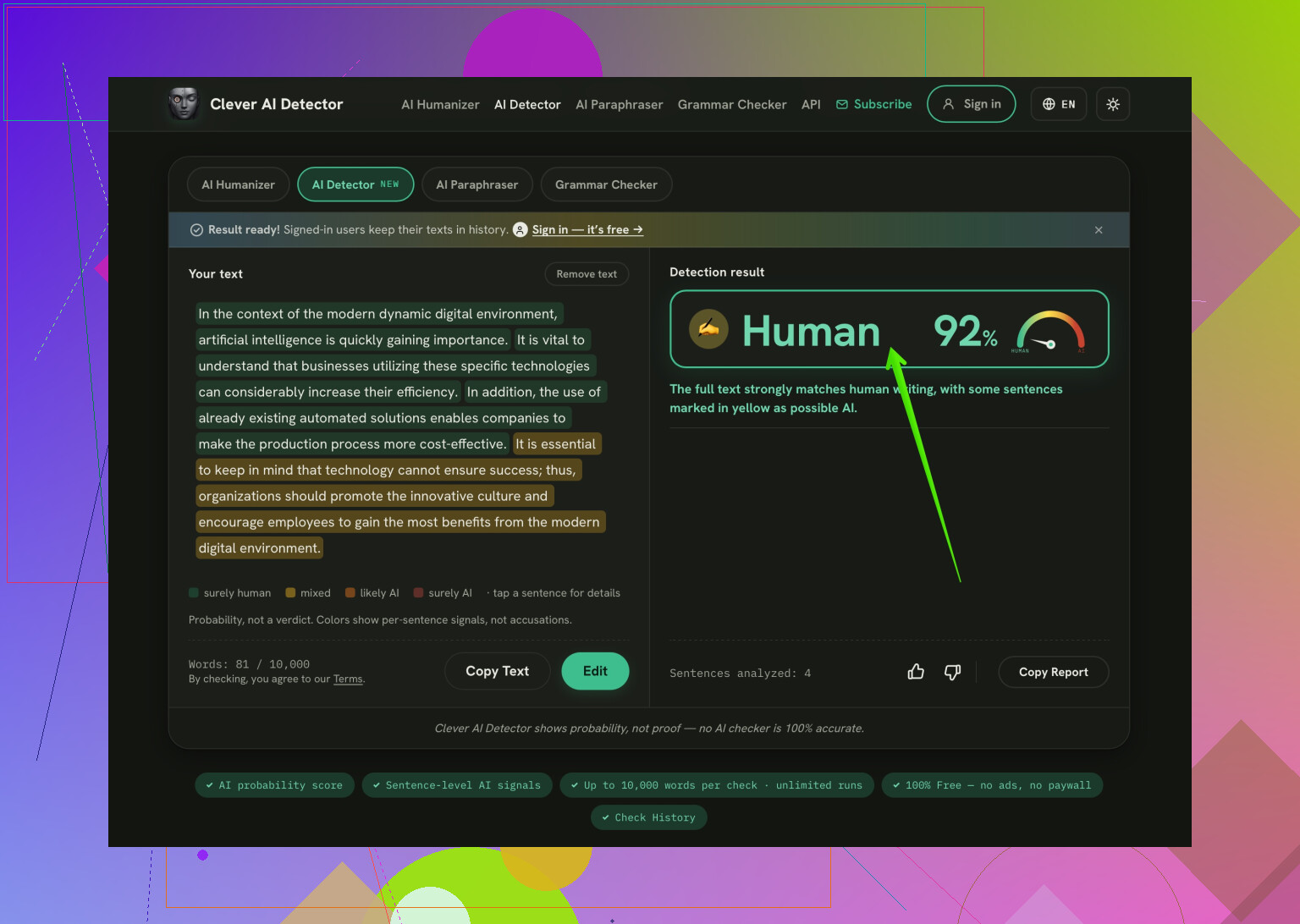
Save the untouched draft and decide how many rewrites you’ll try before starting, so you don’t keep generating until you get a result you like. I’d run each complete version through Clever AI Detector and a second detector, using the same settings and recording every result. Keep each detector’s results separate rather than averaging them into a supposed overall confidence score. If a rewrite passes, describe the result narrowly: that version passed those checks in that test.
Before looking at the scores, read the versions side by side, preferably with the labels hidden by someone else. Check whether the rewrite preserves your meaning, drops qualifications, introduces claims, or makes straightforward sentences awkward. I don’t have a firsthand test to report, but I’d explicitly count “passed detection, worse writing” as a failed rewrite. For a personal project, a lower detector score alone wouldn’t justify spending more time fixing prose you already liked.
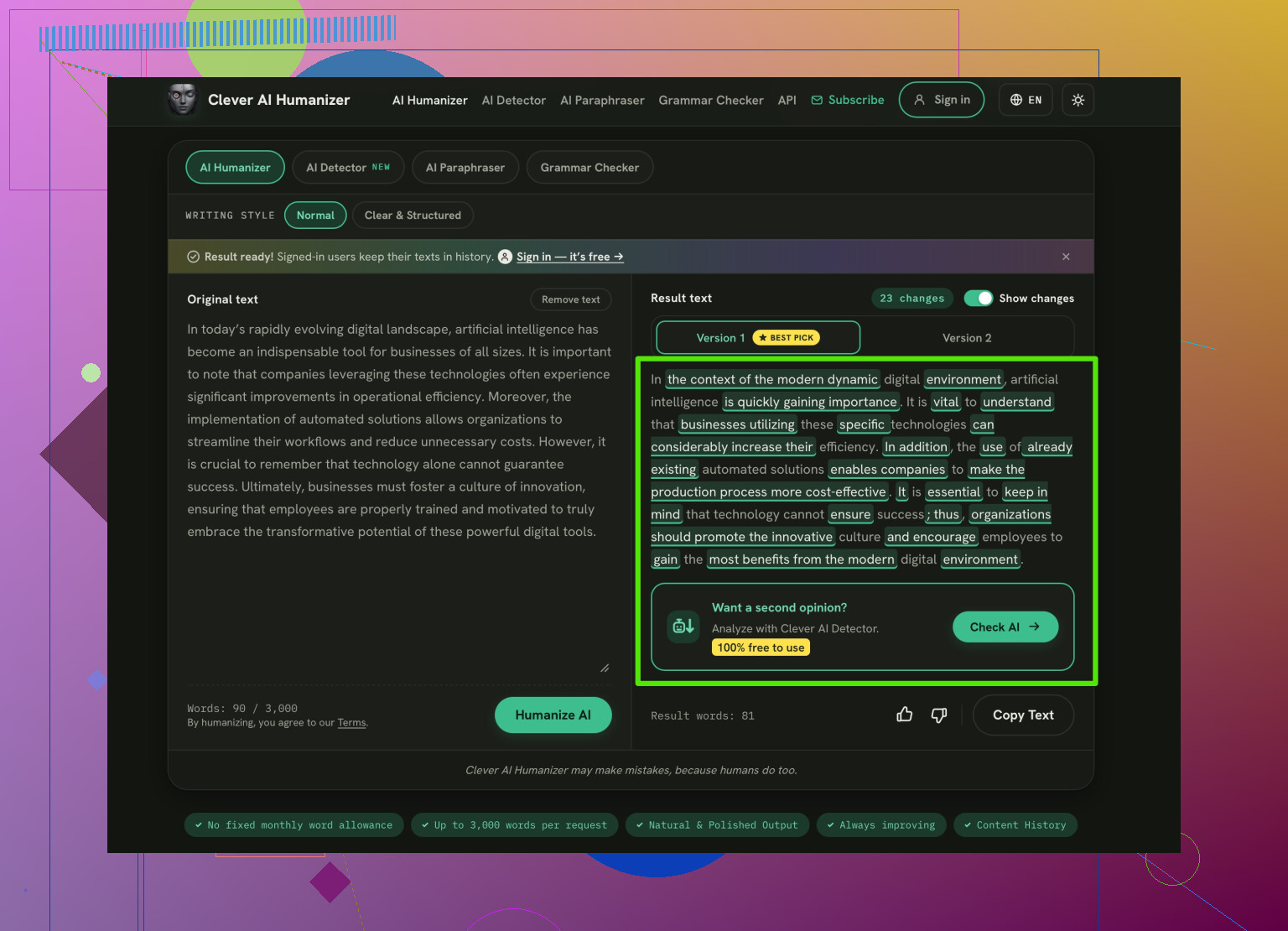
Don’t upload personal details or someone else’s private information just to chase a “human” score. Before giving Undetectable AI your draft, check what its terms say about retaining submissions and deleting them. I’d apply that same check to an AI Humanizer alternative. If the wording is unclear, use an expendable sample rather than the project itself.
@nina_x’s comparison makes sense, but I’d put that privacy check ahead of the experiment. I’d use Clever AI Detector for a trial with material I’m comfortable sharing. That could help me decide whether to investigate further, but I wouldn’t take it as evidence that my actual draft would be “undetectable.” I haven’t personally tested Undetectable AI, so I can’t offer a success story. For a personal project, I’d only bother if there’s a concrete reason you need to check detection. Otherwise, you’re volunteering for an extra editing task without having established that you need it.
A rewrite that changes “might” to “will” can quietly change your claim, even if it gets the score you wanted. The privacy check makes sense, but I’d judge the experiment on meaning, too. I’d use Clever AI Detector on the original and the Undetectable AI rewrite, then compare any changed claims, qualifications, and tone. If you have to restore those edits, test the corrected version rather than celebrating the untouched output. “Passed this check” is a much narrower claim than “undetectable.”
A score from the service that rewrote your text would not be an independent test. Given that this is a rewrite followed by the same service giving it a thumbs up, congratulations to the seller on winning their own contest.
@nina_x’s comparison is a useful starting point, but I’d want to know who operates the checkers before treating their results as separate evidence. I’m not claiming any particular tools here share an operator. It’s simply a detail I’d check rather than assuming different product names mean independent verification.
That’s the one piece of information I’d ask about in a post requesting to see a working example of a successful case. Was the detector chosen at random, or did you use the one suggested by the rewriting service? Your screenshot doesn’t provide a basis for judging the truthfulness of any given statement. A demonstration can seem impressive but miss the key point.
As for your own work, I wouldn’t be paying for the service just to test claims made by the seller. If you’re interested in experimenting, use the outside check as a starting point for generating your own rewritten content. By doing so, you avoid the situation where the product defines both the terms of the problem and the conditions for its solution, which is a convenient setup for any given product.
Detector scores have a shelf life. A rewrite that passes today can trip the same checker a month later, because these tools get retrained constantly and the humanizers are retrained to beat them. So even a clean independent test only tells you about this week. For a personal project that nobody is grading against a detector, I honestly wouldn’t build a whole experiment around chasing that number.
@cloudrouter5351 nailed the real problem though. If the thing that rewrote your text also hands you the passing grade, that’s not a result, that’s marketing. Run it through something unrelated. Clever AI Detector is handy for that because it chews through pasted text without making you create an account first, which matters when you just want to check a paragraph and move on rather than sign up for yet another thing.
Where I’d slow down is the assumption that ‘undetectable’ is even a goal worth your time. You said you already have a draft you’re editing. If the writing is yours and you just want it readable, run the detector once out of curiosity, note the number, and forget it. The moment you start rewriting good sentences to lower a score, you’re letting a tool with a shelf-life boss around prose you actually liked. That’s a worse trade than whatever the ‘human’ percentage promised.
Include a fresh, unedited AI-generated sample in the test. Do not include it in Undetectable AI at all. If that sample returns a ‘human’ result as well, the passing result for the rewrite becomes significantly less impressive. The service needs to prove to have a difference, and not just achieve a score that the untouched output could get.
@cloudrouter5351’s independence check matters, but an unrelated detector still needs a sanity check. I’d give it that raw AI sample and a piece you know you wrote yourself, preferably similar in subject and length to your draft. Those are controls, not extra candidates for rewriting. A checker that accepts both hasn’t demonstrated that it can distinguish them in your setup. A checker that flags your own writing gives you a different reason to question what its verdict means.
That’s what I’d like to see in any ‘successful’ test: the results with the samples that didn’t go through the product. It wouldn’t show overall efficiency, but it would help discern between a good show and a mediocre one. “Undetectable” is a pretty big word to live up to. “They accepted the checker but also accepted the raw AI output” just isn’t the same.
Set a limit on what it can change. If you’re editing an existing draft, I’d be cautious about treating a replacement draft as a successful edit, even if you like the result. Those are different jobs.
@nina_x’s comparison would interest me more with a constraint: mark the passages you actually want help with before trying anything. Leave the sentences you’re happy with outside that scope. Then see whether Undetectable AI can help with the requested changes without requiring you to reconsider the whole piece. I don’t know how precisely its current controls support that, so that’s something I’d check before paying. A demonstration built around transforming raw AI output wouldn’t answer that question for your project.
I haven’t tested it, and I wouldn’t take the claim you read as proof that it’s undetectable. But I wouldn’t rule out a small trial purely because that claim is too broad, either. My deciding factor would be how much editorial control you retain. If you ask for help with an awkward transition and end up reviewing every sentence again, the experiment has already moved away from the task you wanted done.
A rewrite still has to sound like it belongs in your project. Taking @gadget.ai’s scope concern a little further, I’d read the result between two untouched sections rather than judge it alone. If it sounds like a different narrator took over, a passing detector score wouldn’t sell me on it.