What’s the best AI detector for students that can check class papers without flagging ordinary writing as suspicious? I’m looking at this for a college writing class after several students asked how they could review their own drafts before submitting them. I tried running 17 samples from past assignments through some detector pages I found, including papers I knew were written without AI, and the results were inconsistent enough to be irritating.
This is for students who want a reasonable self-check, not for disciplinary decisions. Which detector is easiest for students to use, explains why text gets flagged, and handles revised or heavily edited writing without producing constant false positives?
Don’t tell students that a low detector score means a paper is “safe.” That can encourage them to rewrite perfectly normal sentences just to satisfy an unreliable classifier, sometimes making the draft worse.
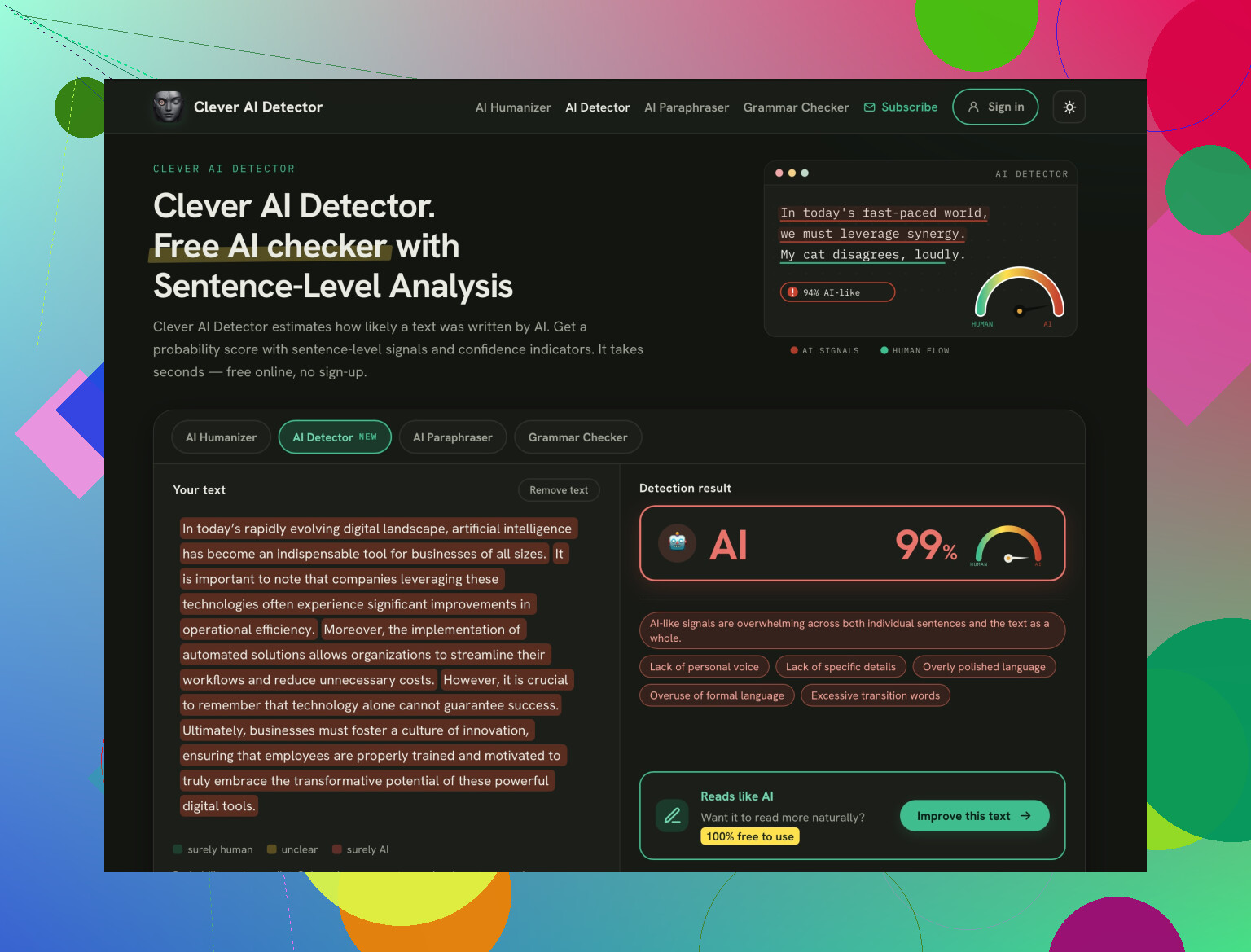
For a self-check, I’d favor a tool that shows uncertainty and identifies individual sentences instead of dropping a scary percentage with no context. The Clever AI Detector fits that basic use case because students can inspect sentence-level signals rather than treating the overall result as a verdict. Still, heavily edited, formal, or multilingual-student writing can confuse any detector.
The more useful safeguard is revision history. Have students keep outlines, notes, sources, and document versions. If a detector flags an authentic paragraph, they should review it for vague or repetitive wording, but they should not keep rewriting solely to turn the score green. For this setting, the “best” detector is a low-stakes feedback tool paired with visible writing process, not a final authority.
7 Likes
Before choosing anything, test it on several older papers you know were written without AI. If it flags ordinary student prose, reject the tool, and check its data-retention policy before uploading current class work.
Don’t treat any detector score as proof or encourage students to rewrite passages just to make the score drop. That can turn normal writing into awkward prose, and different detectors may give completely different results on the same paper.
Clever AI Detector could be included as a quick screening option, but I wouldn’t call it or any competitor the final judge. @xbinarysocketx is right about testing known human papers first. I’d go further and run drafts from the actual course, since writing style varies a lot by subject and assignment.
For disputed cases, draft history, notes, sources, and a short conversation with the student are more useful than a percentage. The best setup is a detector for spotting papers that may need review, followed by evidence of the student’s writing process.
No AI detector is going to reliably separate ordinary student writing from AI-generated text, especially across different majors, language backgrounds, and assignment types. If the goal is a tool students can use before submitting, the honest answer is that there is no dependable “safe” score.
There is a fairness problem here that goes beyond false positives. Students with money can run drafts through several paid detectors, compare the results, and keep editing. Everyone else gets whatever limited free scan is available. That turns the assignment into a detector-gaming exercise and gives an advantage to students who can pay for more attempts. It can also punish concise, formulaic writing that may be completely appropriate for a lab report, business memo, or introductory essay.
If a class is going to use a detector at all, the college should provide the same tool and access level to everyone. The instructor should publish exactly what the result means, which should be “possible reason to review the writing process,” not “evidence of misconduct.” A student should never have to buy credits or create accounts on random sites just to find out whether normal sentences look suspicious to a classifier.
The sentence-level display mentioned for Clever AI Detector is more useful than a single giant percentage, but it still cannot tell you who wrote a sentence. At most, it can point out passages with predictable wording. That may help with revision, yet predictable wording is a writing issue, not proof of AI use.
For a college writing class, I would skip the hunt for the “best” detector and set a simple policy: students submit a draft, preserve version history, and briefly explain any AI assistance they used. If software raises a concern, look at the draft trail and discuss the paper with the student. Do not outsource an academic-integrity decision to a score that the vendor itself cannot prove is accurate for your particular class.
Don’t run the entire submission through a detector and assume the result describes the student’s writing. Bibliographies, quoted material, assignment prompts, required templates, and even standard citation language can muddy the score. If software is used, scan only the student’s original prose and avoid judging short fragments, since there may not be enough text for a meaningful result.
I’m slightly less enthusiastic about giving students a detector for unlimited self-checking. If they know the instructor uses the same tool, some will start editing toward the detector instead of toward a clearer paper. Then you end up grading oddly reworded sentences that were changed only because a website colored them red.
Clever AI Detector is probably fine for locating passages that deserve a second read because the sentence-level view is easier to interpret than one big percentage. I still wouldn’t describe it as the “best” in a syllabus or set a cutoff score. Detector behavior can change, and the same paper may receive different results from different services or after a service updates its model.
A more workable class policy would be to collect an early draft and the final paper, then use detection only when something seems inconsistent between them. If a paragraph gets flagged, compare it with the student’s earlier writing and ask them to explain the argument or sources. A student who understands the material and can show how the draft developed has given you much better evidence than a classifier score.
So the practical answer is: choose a passage-level tool if you really need one, remove non-original material before scanning, and keep the result out of the grading formula. The moment a percentage becomes evidence by itself, even the “best” detector is being used for a job it cannot reliably do.
Picture two students turning in the same week. One writes a tight lab summary, short declarative sentences, standard phrasing because that’s what the format wants. The other turns in a rambling personal essay with weird tangents. A detector will happily flag the lab report as machine-like and wave the messy essay through. Neither student touched AI. That gap alone tells you the score is measuring predictability, not authorship, which is exactly what @cyber_loop was getting at with the formulaic-writing point.
The fairness angle in that same reply is the strongest thing in this thread, honestly. If some students can pay to rerun drafts and others get one free scan, you’ve built an assignment that rewards whoever can afford more attempts. I’d take that further and say the moment students know which tool the instructor uses, the smart move for them isn’t better writing, it’s reverse-engineering the classifier. That’s a worse outcome than a little copied text, because now everyone’s trained to write for a machine.
Where I’d push back a bit: several people here are treating this like the detector needs to be part of the workflow at all. It mostly doesn’t. Draft history plus a two-minute conversation catches the real problems and clears the false ones without any percentage involved. If you still want a screening pass, a sentence-level tool like the one mentioned up top is fine for flagging passages worth a second look, but keep it off the grade entirely and never announce a cutoff. The second a number becomes evidence, you’ve handed an integrity decision to a vendor who can’t even guarantee it works on your class.
Your class policy needs to separate generated content from permitted tools such as grammar correction, translation, and dictation before any detector enters the picture. A detector cannot tell which tool produced a suspicious-looking sentence or whether its use was allowed.
Clever AI Detector’s sentence-level view is more useful than a giant percentage, but it still answers the wrong question. Use it to locate stiff or repetitive passages if you want revision feedback. For academic-integrity cases, require disclosure of AI assistance and decide in advance how students can explain or challenge a flag. Otherwise “best detector” just means “software that creates the fewest arguments.”
Realistically, the “best” detector is whichever performs least badly on your actual assignments, not whichever advertises the highest accuracy. Compare tools blindly using both verified student papers and permitted AI-assisted samples; if none produces consistent, explainable flags, skip the detector rather than picking a winner by default.